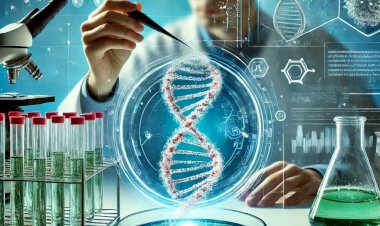
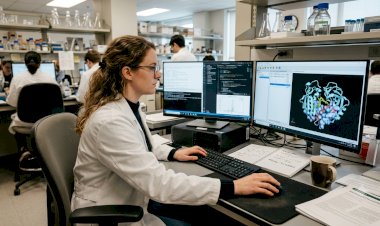
From Pipettes to Python: Why Biology's Next Big Breakthroughs Will Be Written in Code
How IBRI's new 6-month diploma is preparing India's life-science talent for the AI revolution in biology.
 Sheetal
Aug 24, 2026 03:36
462
0
Sheetal
Aug 24, 2026 03:36
462
0
How IBRI's new 6-month diploma is preparing India's life-science talent for the AI revolution in biology.
There was a time when a biology degree meant a lifetime at the bench — pipettes, gels, and long hours waiting for cultures to grow. That world hasn't disappeared, but it now has a powerful new collaborator: artificial intelligence.
AlphaFold solved a 50-year-old protein-folding problem in a matter of days. AI models are screening millions of drug candidates before a single molecule touches a lab bench. Hospitals are using deep learning to catch cancers in scans that the human eye might miss. The scientists driving this revolution aren't just biologists, and they aren't just coders — they're both.
That's the exact space the Indian Biological Sciences and Research Institute (IBRI) built its new diploma to fill.
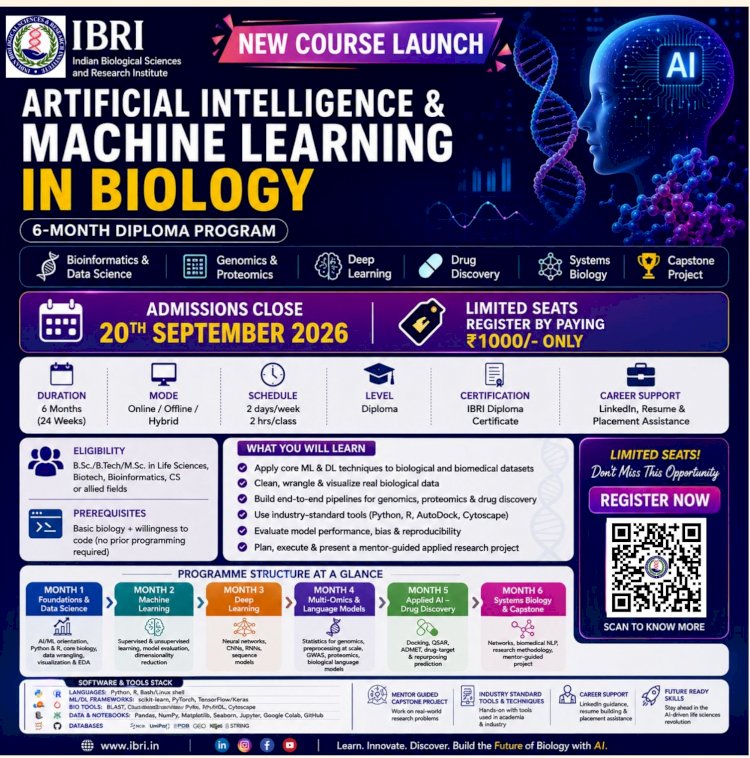
Introducing the Diploma in Artificial Intelligence & Machine Learning in Biology
This is a 6-month, mentor-guided programme (24 weeks, 2 classes a week) designed for exactly the kind of person reading this: a life-sciences graduate curious about code, a computer science graduate curious about biology, or a working professional who knows the industry is shifting and wants to shift with it.
No prior programming experience is required — just a working knowledge of basic biology and a genuine willingness to learn. IBRI takes you from your first line of Python to a full research-grade capstone project, with real biological data at every step.
What You'll Actually Learn — Month by Month
The programme is structured like a research journey, not a textbook:
- Month 1 — Foundations: Python, R, GitHub, and the biological literacy (central dogma, omics data types, file formats) every computational biologist needs.
- Month 2 — Machine Learning: Supervised and unsupervised learning applied directly to gene-expression and clinical datasets — including a project classifying cancer subtypes from real RNA-seq data.
- Month 3 — Deep Learning: Neural networks, CNNs, and sequence models, culminating in a histopathology image classifier you build yourself.
- Month 4 — Multi-Omics & Biological Language Models: GWAS analysis, protein structure prediction, pathway enrichment, and hands-on work with models like ESM and DNABERT.
- Month 5 — Applied AI in Drug Discovery: Molecular docking with AutoDock Vina, QSAR modelling, and drug-repurposing prediction — the same workflows used in pharma R&D pipelines.
- Month 6 — Systems Biology & Capstone: Network biology, biomedical NLP, research methodology, and a fully mentor-guided capstone project you'll defend live.
Along the way, you'll work with the same tools used in real labs and companies — Python, R, scikit-learn, PyTorch, TensorFlow, BLAST, PyMOL, Cytoscape — and pull data from databases like NCBI, UniProt, PDB, GEO, and KEGG.
The Capstone: Your Own Research Story
Every learner exits the programme with a portfolio-ready capstone project in a track of their choosing:
- Oncology & Diagnostics
- Infectious Disease & Immunology
- Structural Bioinformatics
- Drug Discovery
- Single-Cell & Transcriptomics
This isn't a toy exercise — it's a full project with a written report, a code repository, and a live defense, built to mirror what you'd actually be asked to do in a research lab or an industry R&D team.
Built for Research Scholars, Not Just Career-Switchers
If you're a graduate student or research scholar, this diploma isn't a detour from your research — it's an accelerant for it. Learning to apply ML to your own omics, imaging, or clinical data means faster analysis, stronger papers, and the kind of computational fluency that reviewers and PIs increasingly expect. The Month 4 focus on GWAS, pathway enrichment, and biological language models, and the Month 6 module on research methodology and scientific writing, are built specifically with scholarly output in mind.
Beyond the Classroom: Career Support That Actually Helps
IBRI backs the technical training with real career infrastructure, at no extra cost:
- Free LinkedIn profile creation & enhancement
- Free resume building, tailored around your capstone and tools stack
- Placement assistance with hiring partners in bioinformatics, biotech, and AI-driven research
The Details
|
Duration |
6 Months (24 Weeks) |
|
Schedule |
2 days/week, 2 hours/class |
|
Mode |
Online / Offline / Hybrid |
|
Eligibility |
B.Sc./B.Tech/M.Sc. in Life Sciences, Biotech, Bioinformatics, CS, or allied fields |
|
Certification |
IBRI Diploma Certificate (on capstone completion) |
|
Fee |
₹50,000 (Early Bird: ₹45,000) |
Only 20 seats are available, allotted first-come, first-served, and admissions close on 20th September 2026. You can lock in your seat with a refundable registration of just ₹1,000, deducted from your final fee.
Ready to Write Biology's Next Chapter — in Code?
The line between biologist and data scientist is disappearing. The researchers who thrive over the next decade will be the ones comfortable on both sides of it.
Register here to secure your seat.
Questions? Reach out to us: ???? info@ibri.org.in | ???? +91 99995 09892 / +91 99714 41910 ???? ibri.org.in
Join our WhatsApp group for more info https://chat.whatsapp.com/CO2kWD4bqv1D2YJdtupqLs
Indian Biological Sciences and Research Institute (IBRI) C-50, 2nd Floor, Sector 2, Noida, Uttar Pradesh, India