Regulatory Affairs in 2026: Scope, Salary and Hiring in India
Explore regulatory affairs careers in 2026: India salary ranges, who is hiring, CDSCO and FDA trends, and how AI is changing RA roles in pharma and biotech.Explore regulatory affairs careers in 2026: India salary ranges, who is hiring, CDSCO and FDA trends, and how AI is changing RA roles in pharma and biotech.
 Mithilesh Kumar MIshra
Oct 8, 2026 11:02
45
0
Mithilesh Kumar MIshra
Oct 8, 2026 11:02
45
0
Regulatory affairs (RA) is one of the most in-demand career paths in pharma, biotech and medical devices. This post covers pay, who is hiring, and how AI is changing the field, with a focus on India
What regulatory affairs actually is
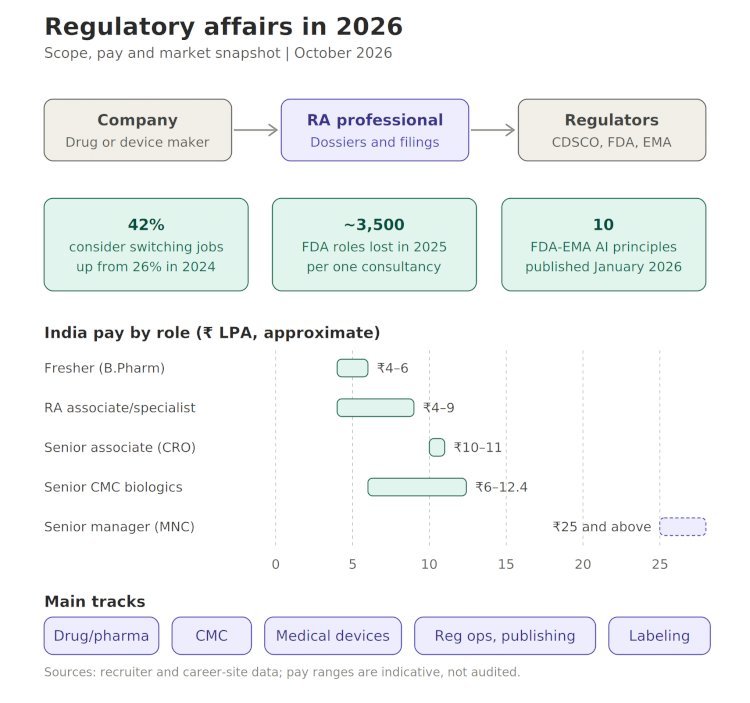
RA professionals are the link between a company and the authorities that approve its products: CDSCO in India, the FDA in the US and the EMA in Europe. In India, a drug must get CDSCO approval before it can be sold. Day-to-day work covers submissions and dossiers, agency correspondence, labeling, variations and renewals, and post-market compliance.
The roles fall into rough tracks:
Drug/pharma RA: dossiers, CTD modules, filings with CDSCO, FDA and EMACMC regulatory: manufacturing and quality sections, especially for biologicsMedical device RA: growing as India’s device sector expandsRegulatory operations and publishing: compiling and submitting documentsLabeling and promotional reviewGovernment regulator roles: for example, CDSCO announced a 2026 recruitment drive for 40+ Drugs Inspector posts, with pay up to about ₹1.51 lakh
The global picture
Agencies are under strain. One consultancy reports that the FDA lost roughly 3,500 full-time positions in 2025, which makes the environment more demanding for companies dealing with it. With less agency capacity, submission quality matters more.Professionals are restless. The same source cites a survey in which 42% of RA professionals are considering a job change, up from 26% in 2024. That is a single recruiter-cited survey, so treat it as a signal rather than a fact.Credentials still count. RAPS’ Regulatory Affairs Certification (RAC) is still described as the gold standard credential. The same source says cross-jurisdiction knowledge is becoming a baseline expectation, not a differentiator.
The AI shift
This is the biggest change for RA careers.
Regulators are setting AI rules. In January 2026, the FDA and EMA issued 10 joint guiding principles for AI across the medicines lifecycle. They are not binding yet, but future guidance will build on them. For devices, the EU AI Act classifies AI medical devices as high-risk, requiring conformity assessments and human oversight.What AI does well today. Gap analysis of drafts against templates such as ICH CTD modules and FDA checklists, literature triage, regulatory tracking and document cross-referencing. Speeding up submission document preparation is described as the most widely adopted generative AI use.What it does not replace. The consensus is that AI takes over tasks, not the profession. One summary puts it as: AI will not replace regulatory affairs managers, but it is already replacing some of the work they do. Agency negotiation, strategy and accountability stay with people.The new skill gap is practical. Recruiters describe a widening gap between people who can engage with AI at a regulatory level and those who cannot. One example is a candidate who could explain how they would document AI-assisted literature screening in a submission, covering traceability, validation checks and reviewer oversight. People with both regulatory knowledge and AI literacy are described as an uncrowded talent pool, which is a podcast-level claim rather than hard data.
Pay
Figures vary a lot by source, country and seniority.
US: One recruiter reports a national median of $85,000 for a Regulatory Affairs Specialist, ranging from $65,000 at entry level to $115,000 at senior level. Big metros pay more; Robert Half shows a Washington, DC range of roughly $107K–$150K.
India: Indicative ranges from career blogs and job postings (not audited data):
|
|
|
|
|
|
|
|
|
|
|
|
|
|
|
|
|
|
The LPA figures for specific employers are rough estimates, not confirmed offers.
Who is hiring in India
Indian pharma: Sun Pharma, Cipla and other large firms, which hire for filings and approvalsMNCs and device companies: Masimo (RA specialist), Cencora (CMC biologics) and ClinChoice (senior RA associate)Regulator: CDSCO, through its 2026 inspector driveGlobal capability centres: one career site notes they need this role, though it does not name employers
Experienced roles ask for real depth. A Mumbai-based pharma manager posting from August seeks 5–8 years of RA experience with hands-on India expertise, including managing submissions and dealing with CDSCO. Freshers should expect to start as associates or executives and build from there.
Routes into RA
Degrees: B.Pharm, M.Pharm (Regulatory Affairs or QA/RA specializations), life sciences, or biomedical/device backgroundsCertifications: RAC (US/EU/Global) is the main international credentialSkills to prioritize: ICH guidelines, CDSCO/USFDA/EMA frameworks, CTD dossier writing, project management and basic AI literacyInterview focus: in-depth knowledge of guidelines such as ICH, USFDA and CDSCO, and experience with submissions
What this means for you
Specialize. CMC (especially biologics), medical devices and regulatory operations are growing niches.Pick up AI literacy now. It is becoming a differentiator, and the agencies’ January principles show where documentation expectations are heading.Consider RAC if you want global mobility.Do not overread the salary numbers. Benchmark against listings for your specific role, city and company type.If you also like data/AI, RA combined with bioinformatics or ML is a strong mix, since regulators now scrutinize AI-derived evidence.
Caveats
Several sources are educational or recruiting sites with a motive to promote the field, and salary numbers differ between them. No audited quarterly hiring data for RA was found, so this cannot say whether hiring is rising or falling. As with the bioinformatics report, job-board counts are not the same as industry hiring.